
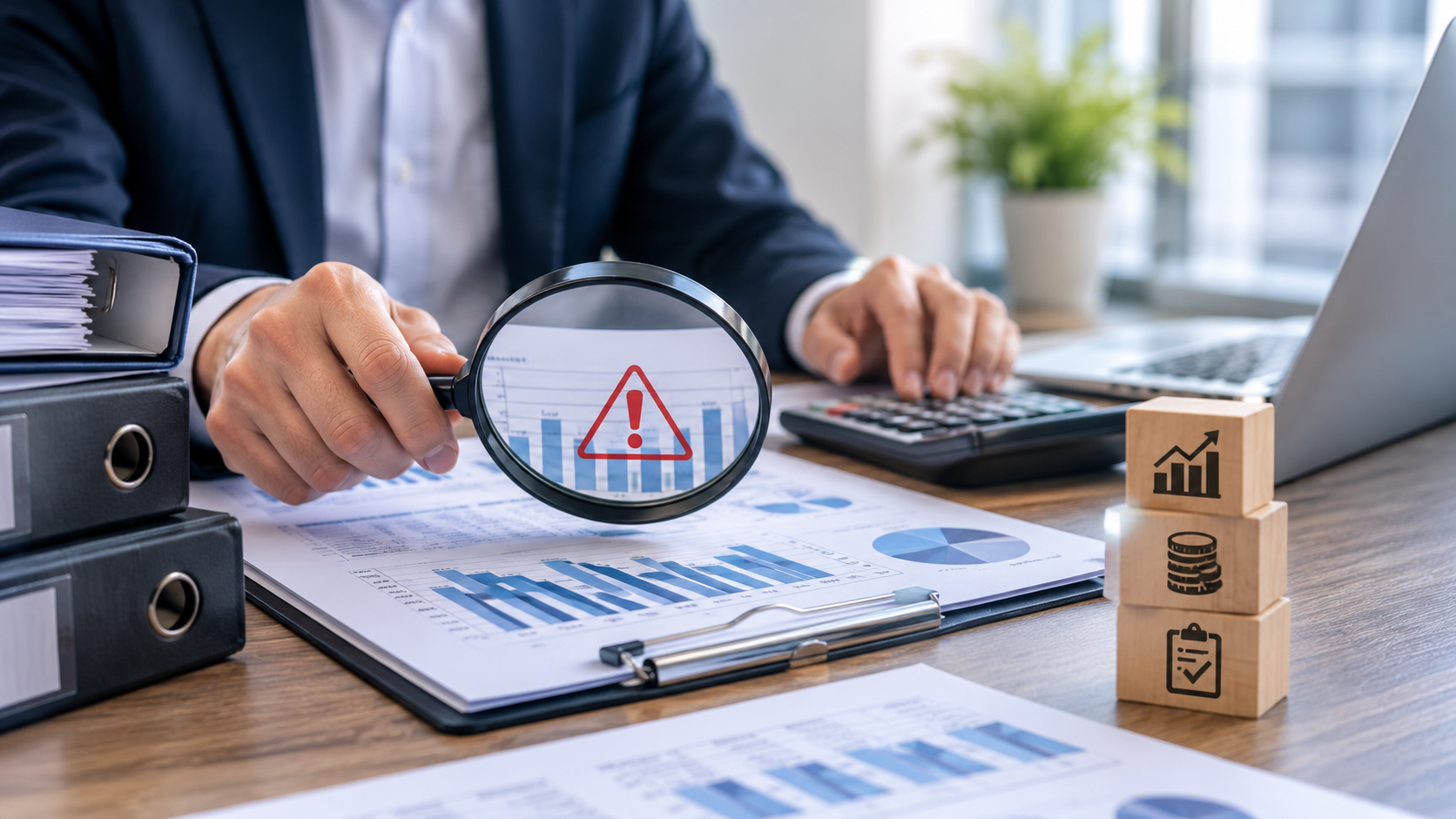
A company can have good sales and run smoothly, yet still not know its actual profit or how much cash it has on hand to meet its obligations. In most cases, the cause isn’t the size of the business but mistakes in how financial transactions are recorded and tracked.
An accounting error sometimes starts with a wrong figure in the books, but often it starts earlier: disorganized accounts, no consistent way of recording transactions, or decisions made without reliable numbers. As these mistakes repeat, reports lose their credibility, and management struggles to evaluate performance or plan the next stage.
What Are the Most Common Accounting Mistakes in Companies?
The most common accounting mistakes in companies fall into seven areas: delaying the recording of transactions, having no clear accounting system, mixing personal and business accounts, poor cash flow monitoring, making decisions without accurate data, neglecting account reviews and reconciliations, and keeping poor records of supporting documents. Each can be avoided by organizing accounting work and reviewing it regularly.
1. Disorganized Accounts and Irregular Transaction Recording
When financial transactions are postponed or recorded in no particular order, it becomes hard to trace the flow of money. Revenue and expenses may land in the wrong period, the same transaction may be recorded twice, or details of past transactions that the accountant needs later may be lost. And if sales are recorded without tracking how much has actually been collected, management sees more liquidity than the company really has. The solution is to record every transaction as soon as it happens, in the right account, and to keep the document that supports it.
2. No Clear Accounting System for Managing Financial Operations
Scattered files and unconnected records are enough when a business is just starting out, but they become a source of problems as transactions multiply and the number of customers, suppliers, and expenses grows.
A clear accounting system gathers data in one organized place, makes it possible to follow accounts, and produces the reports management needs. In many companies, the system doesn’t need to be complicated, as long as there is a consistent way to record transactions, review them, and keep the data up to date.
3. Mixing Personal Accounts with Business Transactions
Using business funds for personal expenses, or paying company expenses from the owner’s own account without recording it properly, blurs the company’s financial position. It becomes harder to determine the business’s actual expenses, profits, and liabilities, giving an inaccurate picture, and management can’t tell whether company money is being used for operations or for something else. The solution is to keep the two accounts separate and to record anything the owner withdraws or contributes according to its accounting nature.
4. Poor Cash Flow Monitoring
Accounting profit does not mean cash is available. Suppose a company records half a million Egyptian pounds in credit sales during the month, and the profit shows up in its books. If only a small part of that amount is collected before payday and before suppliers must be paid, the company finds itself unable to pay while being profitable on paper.
This problem arises when incoming and outgoing money isn’t tracked regularly, or when collection and payment dates aren’t known. Monitoring cash flow shows what is actually available, lets you anticipate periods of tight liquidity, and helps you prepare for obligations before they fall due, instead of facing the crisis after it hits.
5. Making Financial Decisions Without Accurate Data
A company may be considering expanding, buying new equipment, or entering a different market, but a decision based on projections alone exposes it to financial risk. Management needs figures for revenue, expenses, liabilities, and cash flow, along with reports that measure actual performance.
A decision to expand, for example, should rest on the company’s financial capacity, an estimate of costs, and the expected return, not on rising sales alone. The more accurate and current the data, the clearer the evaluation of the decision.
6. Not Reviewing Accounts and Reconciliations Regularly
Recording is only the first step, and it doesn’t guarantee accuracy on its own. Balances must be reviewed and matched against supporting documents and account statements, and you need to confirm that transactions were recorded correctly. If account reviews are neglected, errors in expenses, revenue, and customer and supplier balances go undetected.
Periodic reconciliations, such as matching the bank account against the accounting records, reveal discrepancies and their causes and allow them to be fixed before they reach the financial reports.
7. Not Keeping Documents and Invoices That Support Transactions
Every financial transaction needs a document showing its nature, amount, date, and parties. When invoices, receipts, contracts, and collection and payment records aren’t stored in an organized way, it is hard to verify the accuracy of entries, and preparing reports and reviewing accounts takes longer because of the search for missing documents or the need to explain old transactions.
The effect of weak documentation isn’t limited to internal review. It also shows up during a tax inspection. Linking each document to the transaction recorded in the books improves the accuracy of the accounts and makes review and auditing easier.
How Do Accounting Mistakes Affect Your Company’s Performance?
Some mistakes look minor when they happen, but their accumulation affects several areas of how the company is managed. Financial reports no longer reflect the true state of revenue, expenses, assets, and liabilities, and management decisions on planning, expansion, and expense control are made on incomplete or outdated data. Meeting obligations on time becomes difficult when the tracking of collections and payments is weak, and the company bears extra costs to correct errors that were discovered late, in addition to any legal or tax liabilities that may result. On top of all that, management can’t identify which activities are most profitable or where rising expenses come from.
A company can operate for a long time without noticing any of this, until it surfaces as a cash shortfall, discrepancies in the accounts, or a decision that didn’t deliver what was expected.
How Can You Avoid Accounting Mistakes and Improve Financial Management?
Avoiding accounting mistakes isn’t about correcting entries after the fact. It’s about putting consistent procedures in place that reduce the chance of the mistakes recurring. Most of these procedures were covered in the sections above: recording transactions as they happen, separating personal and business accounts, regularly reconciling bank accounts and customer and supplier balances, preparing reports that show revenue, expenses, liabilities, and cash flow, and keeping documents in a way that makes them easy to find.
It also helps to bring in a specialized accounting review that examines the records and assesses how accurate the current procedures are, since the person who prepares the accounts every day will find it hard to spot their own mistakes. The right procedures differ from one company to another depending on the nature of the business and the volume of transactions, so it’s advisable to assess your current accounting system before deciding what needs to change.
When Does Your Company Need Accounting and Auditing Services?
A company needs accounting and auditing services, meaning a review of its accounts, when discrepancies in balances keep recurring, when it struggles to produce clear financial reports, or when it can’t explain rising expenses and falling liquidity. The need grows as the business expands or adds branches and transactions, and before making major financial decisions.
Accounting and auditing services review records and ledgers, verify the accuracy of financial data, and raise the quality of the reports management relies on. Once the earlier mistakes are uncovered, the review identifies the shortcomings in the procedures being followed and addresses them.
How Does Agyad Help Improve the Accuracy of Your Company’s Accounts?
At Agyad for Financial and Tax Consultancy, we start by understanding the nature of the company’s business and its needs. We then review the available data and documents and assess the financial position to identify strengths and weaknesses. Our work with companies includes organizing accounts, reviewing records and ledgers, improving the quality of financial reports, periodic accounting follow-up, and performance analysis tailored to each business.
After the reports are delivered, we continue with follow-up, account updates, and review of results, so management gets a clearer picture of performance and can address problems before they get worse. If you’d like to know how working together begins, learn about our working steps and the stages they include: understanding your company’s needs, reviewing its data, and defining the scope of work.
Start Reviewing Your Company’s Accounts with Agyad for Financial Consultancy
The effects of accounting mistakes don’t appear on day one, but over time they weaken the accuracy of reports, make it harder to track money, and limit management’s ability to make decisions based on clear numbers. That is why reviewing accounts and organizing financial procedures is a core part of managing a company and keeping it stable.
If your company has trouble keeping track of its accounts, or needs to assess the accuracy of its records and financial reports, get in touch with Agyad for Financial and Tax Consultancy. Tell us about your business and the challenges you face, and we’ll work to understand your needs and define the scope of accounting and auditing services that suit your company. Contact Agyad and start discussing your company’s financial needs.